Hard vs. Soft: The Ultimate Guide to Choosing UV Inks

Hard vs. Soft: The Ultimate Guide to Choosing UV Inks

Selecting the right UV Inks is as important as choosing the correct printer, to reduce the chance of failed prints, decrease the need for rework and deliver higher quality finish to your printed products.

As one of leading UV printers suppliers and UV print solutions provider, HOLDWIN is your one-stop print solutions provider which supplies a wide range of printers, all kinds of inkjet ink types and their packaging, such as 1L, 2L, 4L models or cartridge. Holding international CE, RoHS, and ISO standards, we provide high-quality industrial printers and consumables backed by expert technical support. Our certified manufacturing process guarantees reliability for partners worldwide. Explore our Certification Gallery

About UV Ink Technology

UV-Druck relies on ultraviolet light to instantly cure ink across various materials. Unlike traditional inks that dry through slow evaporation, UV inks utilize a rapid photochemical reaction. This flash-curing process prevents bleeding, ensuring razor-sharp image precision on almost any non porous substrate. Additionally, environmentally friendly UV-Tinte meets international environment standards, making it a highly sustainable choice for modern manufacturing.  

Hard oder Soft inks: Understanding UV Ink Types 

Generally, manufacturers engineer UV inks into two primary categories: hard and soft. Hard UV ink features dense molecular cross-linking, curing into a rigid shield where the surface forms a high hardness and high gloss printing effect. Highly scratch-resistant, it is the ideal solution for unyielding, stiff substrates. Conversely, soft UV ink utilizes a specialized blend with a lower cross-link density, allowing the cured layer to retain remarkable flexibility. This elasticity allows the print to stretch, twist, and fold seamlessly with flexible materials without cracking or peeling, ensuring vibrant, durable results even under continuous physical stress.

The Core Differences Between Hard and Soft Ink

Hardness and Elasticity

If your print must resist scratches and keep a glass-like finish, hard ink is the better route. If your print must stretch with the substrate, soft ink is the safer route. The gap is not small: the 3D Soft UV Tinte states that it can stretch up to 200%–300% on flexible materials such as TPU, leather, and soft PVC.

Adhesion and Surface Finish

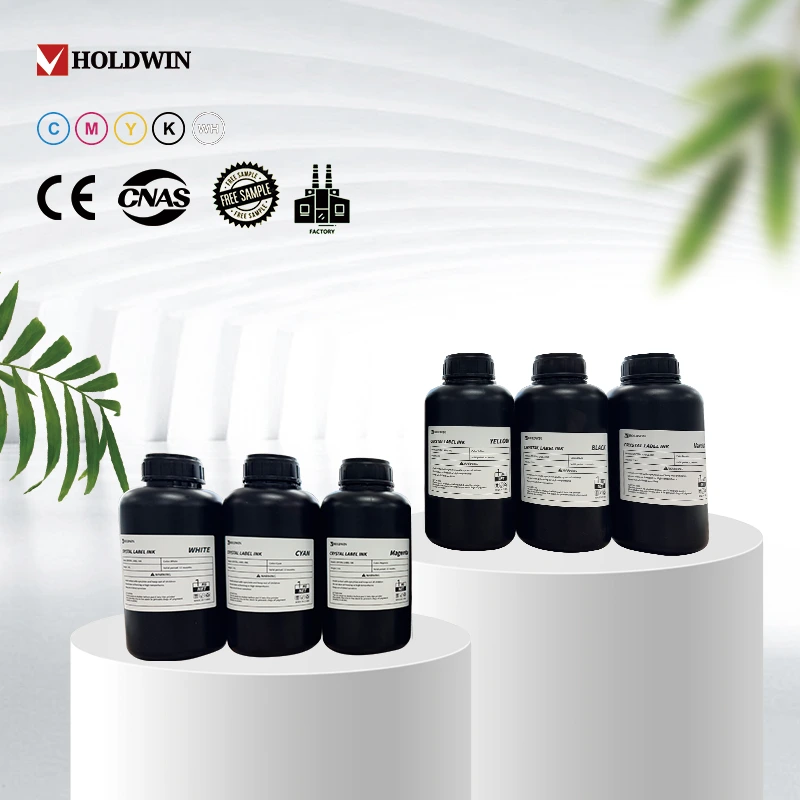
Surface look is the second big difference. The Crystal UV Tinte highlights ultra-high transparency, strong gloss retention, and strong bonding on glass, acrylic, ceramics, and metal. That makes it a smart option when you want clear layers, backlit effects, or a polished decorative result.

Feature / CharacteristicHard UV Ink (e.g., Kristall UV-Tinte)Soft UV Ink (e.g., 3D weiche UV-Tinte)
Cured Film StrengthRigid, stable, and highly wear-resistantFlexible; bends and deforms with the substrate.
ElasticityLow; resists stretching to maintain a glass-like finish.High; capable of stretching up to 200%–300%.
Oberfläche FinishUltra-high transparency with strong gloss retention.High-density color, tactile 3D relief, and soft-hand feel.
Ideal SubstratesGlass, acrylic, ceramics, metal, and non-porous surfacesTPU, leather, soft PVC, and flexible materials.
Best ApplicationsRigid displays, signage, packaging, premium gifts, crystal labels.Leather patches, soft labels, 3D raised logos, flexible branding.
Mismatch RisksImage may fracture or crack if applied to flexible items.Finish may appear weaker or lack necessary gloss on rigid surfaces.

When Hard Ink Is the Better Choice

Hard jobs usually involve rigid display products, signage, labels, packaging decoration, and premium gift items. In these cases, you want the cured layer to stay stable, bright, and resistant to peeling. Here, UV-Tinten should support clean edges, high gloss, and strong bonding on hard surfaces.

Rigid Display and Decorative Work

If you produce acrylic signs, glass panels, metal tags, or crystal-style transfer graphics, Kristall UV-Tinte is the more suitable recommendation. 

3D UV-Tinten

When Soft Ink Is the Better Choice

Soft jobs are different. You care less about a rigid shell and more about flexibility, touch, and durability under movement. For these products, UV-Tinten must move with the substrate instead of fighting against it. That is where a soft-resin formula gives you a real Produktion advantage.

Flexible Branding and 3D Relief

If you print on leather patches, soft PVC labels, TPU pieces, or want raised logo effects, 3D weiche UV-Tinte is the stronger choice. Its product page points to tactile 3D relief effects, high-density color, instant curing, and a soft-hand feel without cracking or peeling. Those features answer a common customer need: premium texture without sacrificing durability.

3D UV-Tinten

Schlussfolgerung

The best choice becomes clear when you compare your material, finish target, and end-use stress. If you need stretch, raised texture, and soft touch, start with 3D weiche UV-Tinte. If you need clarity, gloss, and rigid-surface adhesion, start with Kristall UV-Tinte.

When you match UV-Tinten to the job instead of forcing one formula onto every order, your output becomes more stable and easier to scale. If you want help with product testing or application advice, you can Kontakt HOLDWIN here.

Mehr Beiträge

Senden Sie uns eine Nachricht