Print on Demand Services for T-Shirts: What is POD and How to Start?

Print on Demand Services for T-Shirts: What is POD and How to Start?

Starting a t-shirt brand used to require a massive upfront investment. You had to buy hundreds of shirts in various sizes, guess which designs would actually sell, and turn your spare space into a makeshift fulfillment warehouse. If a design flopped, you were stuck with stacks of unsellable inventory.

Print on Demand (POD) completely changes that equation. With print-on-demand, you can offer unique merchandise without needing to stock any inventory. This model is perfect for starting an online business with minimal upfront investment. When a customer orders from your store, your POD partner will print your design on the product and take care of shipping it directly to them.

But behind every successful POD fulfillment center is the machinery that makes it happen. As a leading digital printing equipment supplier, Holdwin provides the industrial-grade Direct-to-Film (DTF) and Direct-to-Garment (DTG) systems that power high-volume, retail-quality POD production worldwide.

What is Print-on-Demand?

Print-on-Demand (POD) is an e-commerce fulfillment method where products are printed only after a customer makes a purchase.


Unlike traditional printing methods—like screen printing, which requires you to order hundreds of items in advance to get a good price—POD allows you to sell custom products one at a time, with zero inventory.

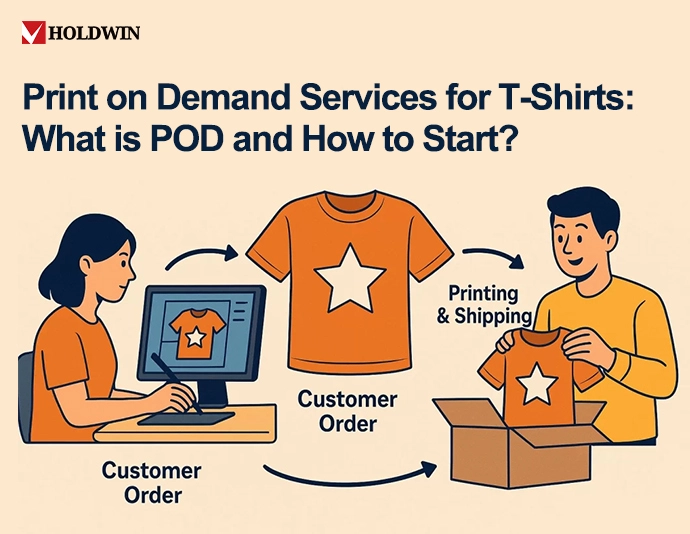
Here is exactly how the process works from start to finish:

[ Customer buys a shirt on your website ]

                   ▼

[ The order automatically routes to your POD printer ]

                   ▼

[ The printer prints the design, packs it, and ships it directly to the customer ]

This approach keeps your costs low since you don’t pay for anything until you’ve made a sale. You can sell all kinds of custom items like t-shirts, hoodies, mugs, tote bags and posters.

Furthermore, it eliminates the hassle of inventory management and warehousing, allowing you to focus entirely on marketing and customer engagement.
print on demand for tshirts

Scale Your T-Shirt Brand with Holdwin

From reliable machinery to expert technical support, Holdwin helps custom apparel businesses around the globe grow seamlessly.

Contact Our Experts

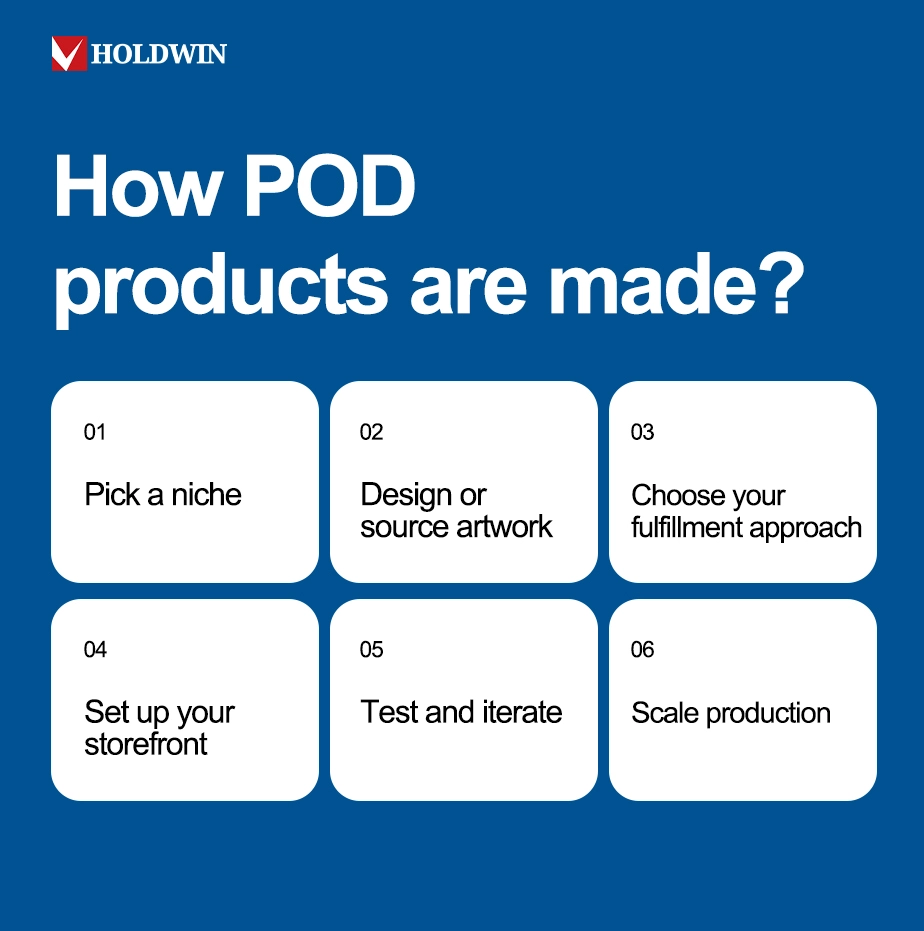
How POD products are made?

The entire print-on-demand workflow is highly automated and beginner-friendly. From the moment a customer clicks “Buy” to the package arriving at their door, digital systems handle the heavy lifting. Here is the lifecycle of a POD order in 2026:

Step-by-Step: How to Start Your T-Shirt Brand

  1. Pick a niche: Broad “funny t-shirts” stores struggle to stand out. Specific audiences (a hobby, a profession, a fandom, a local community) convert better.
  2. Design or source artwork: This can be your own designs, commissioned artwork, or AI-assisted design tools — just make sure you have the rights to sell it.
  3. Choose your fulfillment approach: Start with an outsourced POD platform to validate demand, or go in-house from day one if you’re ready to invest in equipment and expect steady volume.
  4. Set up your storefront: Your online store is your digital storefront where customers will browse your products and place orders
  5. Test and iterate: Track which designs sell, on which product types, and refine from there.
  6. Scale production: Once volume justifies it, bringing printing in-house lowers your per-unit cost and increases your margin on every sale.
how POD products are made

Upgrade to Holdwin’s Premium Printing Quality

As a trusted manufacturer of industrial digital textile printers, Holdwin delivers the high-speed DTF and sublimation technology you need to maximize your profit margins and bring production in-house.

Contact Our Experts

How Print on Demand T-Shirts Are Actually Printed?

“POD” describes the business model, not the printing technology — and the printing method behind your shirt matters a lot for quality, cost, and what kind of designs you can offer. The three most common methods are:

DTF (Direct-to-Film)

Designs are printed onto a special film, coated with adhesive powder, and heat-pressed onto the garment. DTF works on almost any fabric type and color, holds up well to washing, and doesn’t require pretreating the shirt first. It’s become the most popular method for POD sellers because it’s fast, flexible, and works at both small and large order volumes.

DTG (Direct-to-Garment)

Ink is printed straight onto the fabric, similar to how an inkjet printer works on paper. DTG gives excellent detail and a soft feel, especially on cotton, but it’s slower per unit and less forgiving on dark or synthetic fabrics without extra steps.

Sublimation

Dye is turned into gas under heat and permanently bonds with the fibers of the shirt. This method produces vivid, all-over prints but only works well on polyester or poly-blend fabrics and light colors.

For most POD t-shirt sellers today, DTF hits the best balance of print quality, fabric flexibility, and cost per unit — which is why it’s the technology built into most modern POD-focused printers.

Why Focus on Print on Demand T-Shirts?

While POD services now let you print on everything from phone cases to coffee mugs, custom t-shirts remain the ultimate gateway product. Apparel remains the core of the POD industry.

  • Universal Appeal: T-shirts are a staple in almost every wardrobe globally, transcending age, gender, and seasons.
  • Massive Niche Potential: Because shirts are a form of self-expression, people love buying designs that highlight their hyper-specific hobbies, humor, professions, or communities.
  • High Perceived Value: A blank canvas t-shirt that costs $8–$12 to manufacture can easily be sold for $25–$35 if the graphic design resonates deeply with a target audience.

When (and How) to Bring T-Shirt Printing In-House?

Once a business has predictable volume, moving production in-house often becomes the biggest lever for improving profitability. This is where choosing the right printing technology matters:

DTF printers are popular for small-to-medium apparel operations because they work across fabric types, don’t require pretreatment like DTG, and produce durable, vibrant prints — a strong fit for growing t-shirt brands with mixed cotton/poly orders.

DTG printers suit brands focused on detailed, photorealistic designs primarily on cotton garments.

Sublimation printers are the go-to choice for all-over prints and polyester-based apparel like sportswear and performance shirts.

Final Thoughts:

Print on demand remains one of the most accessible ways to start a t-shirt business.

If you’re evaluating that next step, Holdwin (Shaoxing Zhiyu Technology Co., Ltd.) supplies industrial digital textile printing equipment — including DTF, DTG, sublimation, and UV DTF printers — along with the inks, films, and consumables needed to run a complete in-house apparel production line. Get in touch with our team to talk through which printing technology fits your production goals.

More Posts

Send Us A Message