French
 English
 Arabic
 Chinese
 German
 Portuguese
 Russian
 Spanish
 Polish
 Italian

Pour high-speed DTF printing, six printheads are worth considering if your machine runs through large orders every day. Five heads can do the job too, provided the workload isn’t pushing the printer to its limit.
The difference looks simple when you compare specifications. In a workshop, things get less straightforward. You might have a fast printer but a powder shaker that can’t handle the same amount of film. Or the printer is ready for another roll while the previous transfers are still waiting for heat pressing. We’d look at the finished work coming off the line before deciding whether an extra printhead is worth the money.
Understanding the HOLDWIN Multi-Head DTF Printing System
While both configurations share the same base model family—HOLDWIN 605I/DTF900L & 606I/DTF900L printing system—selecting between the 5-head and 6-head setups depends on your daily production volume, ink channel requirements, and speed targets.
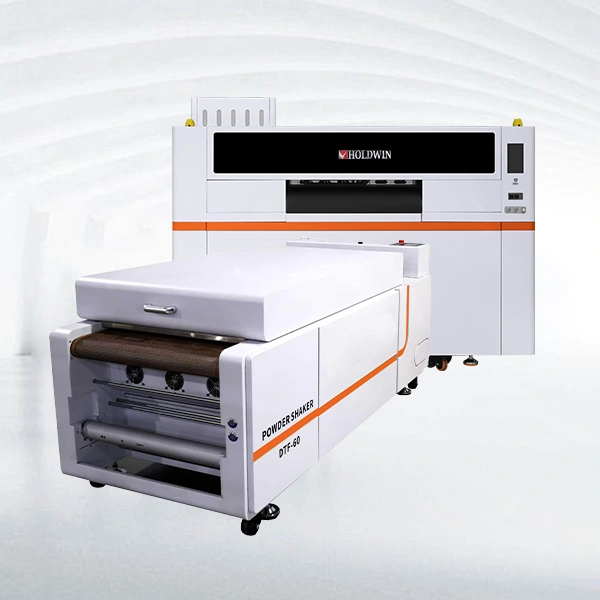
What Can You Expect From a 5-Printhead DTF Printer?
The 5-head configuration of the HOLDWIN 605I/DTF900Ldelivers a cost-effective balance of output speed and manageable operational overhead:
Balanced Production: Easily handles medium-to-high volume garment orders without overloading downstream curing and powdering equipment.
Lower Maintenance Expenses: Fewer printheads mean reduced replacement costs, lower capping station wear, and less daily cleaning fluid consumption.
Cost-Effective Upgrade: Provides an ideal path for print shops scaling up from 2-head or 4-head equipment into continuous industrial production.
When Does a 6-Printhead DTF Printer Make More Sense?
Upgrading to the 6-head setup of the HOLDWIN 606I/DTF900L is designed for heavy-duty, maximum-throughput industrial production:
Maximum Print Speed: Delivers higher square-meter-per-hour output at faster pass speeds to meet tight deadlines.
Expanded Ink Options: Extra channels accommodate specialty configurations, such as double white opacity or spot/fluorescent inks, in a single pass.
Continuous Multi-Shift Operations: Engineered for high-capacity facilities running long film rolls across multi-shift production schedules.
5-Head vs. 6-Head DTF Printer
| Caractéristique | HOLDWIN 605I (5-Head) | HOLDWIN 606I (6-Head) |
| Vitesse d'impression | Fast commercial speed | Maximum industrial throughput |
| Ink Channels | CMYK + White backing | CMYK + White + Fluorescent/Spot |
| Maintenance | Lower replacement & fluid costs | Higher routine care & replacement |
| Meilleur utilisé pour | Steady daily production | Continuous multi-shift long rolls |
How Does Printhead Count Affect DTF Printing Speed?
Adding a printhead gives the machine more inkjet capacity, but the result depends on the way the heads are arranged. The printer’s control system, film movement, and ink delivery all play a part.
You can find several head configurations in our DTF printer range. They’re designed for different production requirements, so comparing the number of heads alone doesn’t tell you everything.
Check the Pass Mode Before Comparing Speed Figures
One detail often gets overlooked when buyers compare DTF machines: the pass setting.
A printer running at 3-pass will generally finish a design faster than it would at 6-pass. That doesn’t mean the faster setting is always suitable for the work you sell. Some designs need more passes to get the required finish.
Conclusion
Five heads may be all you need for regular garment printing. If larger orders are becoming part of your daily work, the extra capacity of a six-head machine is worth looking at.
Nous fournissons technical service and support for our equipment. If you’re comparing these two machines, contacter notre équipe with your expected daily output and the types of transfers you produce.
The number tells you how many passes the printer uses to complete the image. Four-pass printing generally runs faster. Six-pass takes longer and may be useful for designs that need a smoother finish.
Yes. A large order doesn't automatically require six heads. What matters is whether the printer can finish the work before your deadline. Check the expected printing time and allow for powdering, curing, and routine maintenance.
No. The printer's head arrangement, software, and print settings affect the result. To compare five and six heads properly, you need production figures measured under similar conditions.