Polish
 English
 Arabic
 Chinese
 French
 German
 Portuguese
 Russian
 Spanish
 Italian


Why Is Sublimation Printing Used in Home Textile Manufacturing?
With the global home textile market reaching USD 144.76 billion in 2025 (according to The Business Research Company), the industry is increasingly shifting toward agile, customized production. To keep pace with evolving consumer preferences and accelerate new design development, mattress manufacturers, bedding suppliers, furniture brands, and upholstery producers are actively adopting digital printing technologies.
Among these solutions, sublimation printing stands out as an ideal fit for polyester-based home textiles. By using heat to infuse dye directly from transfer paper into compatible polyester fibers, the process yields vibrant, durable designs without leaving a heavy ink layer on the fabric’s surface.
For home textile manufacturers, drukowanie sublimacyjne delivers several key operational and aesthetic advantages:
Vibrant, High-Definition Prints: Reproduce intricate florals, sharp geometrics, smooth gradients, and custom artwork with precision.
Soft, Breathable Hand-Feel: Dye infuses directly into polyester fibers, preserving natural softness without a heavy surface ink layer.
Agile, Screen-Free Production: Launch new patterns and short runs quickly without the time or cost of traditional printing screens.
Wide-Format Capability: Industrial sublimation equipment easily handles large-scale designs and wide fabric bolts.
Versatile Applications: Ideal for mattress ticking, decorative pillows, sofa upholstery, and drapery.

The 4-Step Sublimation Workflow for Home Decor
1. Design Setup & Color Calibration
The process begins with preparing seamless repeat patterns or panel artwork in your design software. Using RIP software and tailored ICC color profiles ensures that subtle gradients, interior color palettes, and skin or neutral tones reproduce accurately across large yardage runs.
2. Printing the Artwork(Transfer or Direct-to-Fabric)
Depending on your production setup, roll width, and output volume, printing with Holdwin High Concentration Sublimation Ink follows one of two main routes:
Paper Transfer Sublimation: Mirrored artwork is printed onto coated transfer paper—the most common route for sharp detail and flexible production runs across Holdwin Sublimation Printers:
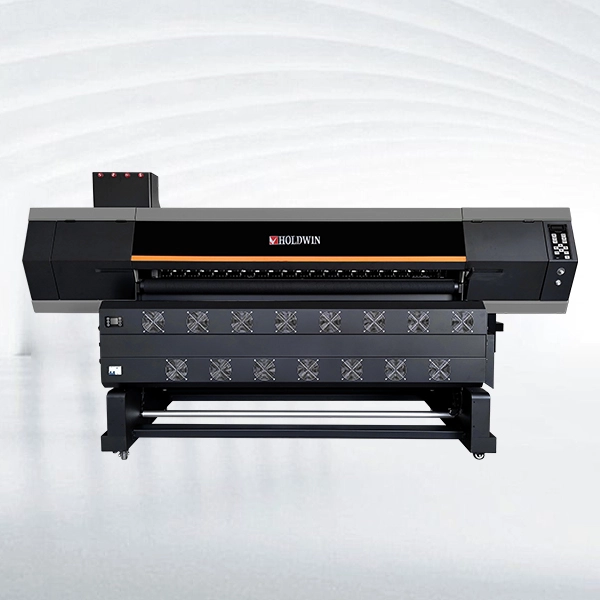
- Standard-Width Production (1.8m–1.9m): For cushion covers, table linens, and mid-size batches, models like the HOLDWIN-1804TX oraz HOLDWIN-1808 TX provide steady precision, while multi-head configurations such as the HOLDWIN-1912 TX oraz HOLDWIN-1916 Pro support high-speed commercial roll output.
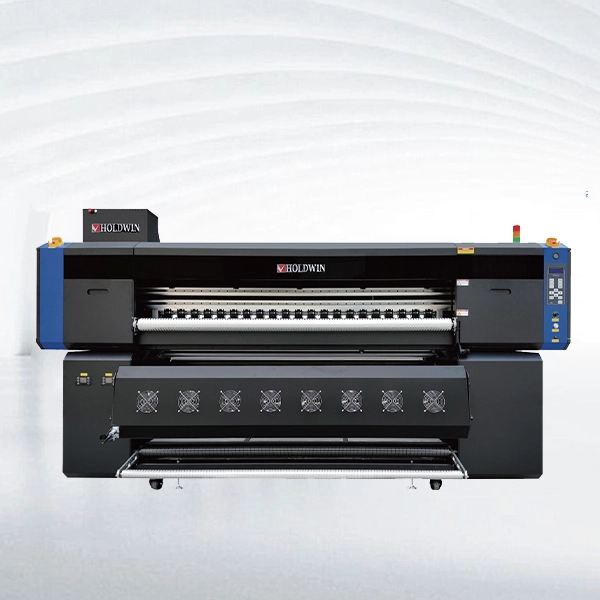
- Wide-Format Production (2.0m):For wide drapery panels, duvet covers, and oversized bedding sets, the HOLDWIN-2008 TX prints full 2-meter widths cleanly in a single pass.
Direct-to-Fabric Sublimation (1.8m–3.2m):To bypass transfer paper on continuous home furnishing yardage, pre-treated polyester rolls run directly through Holdwin Direct-to-Fabric Printers—including the HOLDWIN-1808-i3200 and ultra-wide HOLDWIN-3216-i3200—jetting ink straight onto the textile.
3. Heat & Pressure Fixation
Next, the printed transfer paper and polyester fabric pass through a rotary calender heat press (for continuous rolls) or a flatbed heat press (for cut panels) at approximately 190°C–210°C. Under controlled heat and pressure, the solid dye particles convert directly into gas without becoming liquid, penetrating the open polyester polymer fibers. As the fabric cools, the fibers close and lock the color permanently inside.
4. Cooling, Inspection & Finishing
Once cooled, the printed fabric undergoes a visual check for color uniformity across the full roll width before moving to cutting, hemming, and sewing into finished home decor items.
| Home Textile Application | Recommended Fabric | Suitable Holdwin Printer |
| Pillows, Cushions & Table Linens | 100% Polyester / Microfiber (1.8m – 1.9m) | Holdwin – 1804TX / 1808TX (Standard) |
| Curtains , Drapery & Duvet Panels | Polyester Voile, Blackout & Satin (2m) | Holdwin – 2008 TX |
| Mattress, Covers and Side Borders | Polyester Knit & Jacquard | Holdwin – 1912TX / 2008TX |
| Continuous Home Furnishing Yardage | Pre – treated Polyester Rolls | Holdwin -1808-i3200 / 3216-i3200 |