Portuguese
  English
  Arabic
  Chinese
  French
  German
  Russian
  Spanish
  Polish
  Italian
O que é Impressão Sublimativa?
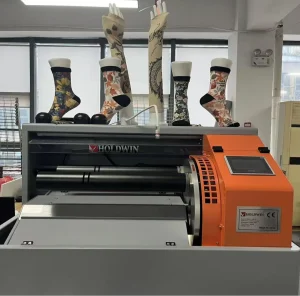
Sublimation printing is a process where solids turn directly into a gas, skipping the liquid phase. In printing, heat and pressure infuse special inks into material fibers.
What is Polyester?
Polyester is a synthetic polymer, also known as polyethylene terephthalate. It is widely used in fashion and sportswear and is increasingly popular for custom prints due to its durability, resistance to wrinkles, and ability to hold vibrant designs.
The Vital Role of Polyester in Sublimation
The Molecular Bond: High temperatures cause polyester pores to open up, allowing the ink to enter. As the fabric cools, these pores close, permanently trapping the color inside the fiber.
Vibrancy and Longevity: The higher the polyester concentration, the more “anchor points” the ink has. This results in sharper details, more saturated colors, and a print that won’t crack, peel, or wash out over time.
The 85% Rule: For retail-quality brilliance, aim for fabrics with at least 85% polyester. While “poly-blends” (like 65/35) can be used for a vintage, faded aesthetic, anything lower will result in a dull finish.
Natural materials like cotton or silk are structurally incapable of bonding with sublimation ink. Because these fibers do not “open up” under heat to accept the gas, the ink simply sits on the surface. Once the garment is washed for the first time, the majority of the image will rinse away, leaving behind a ghosted, muddy, or completely faded transfer.
Why Sublimating on Dark Polyester is Tricky?
Sublimation printers don’t print white. They rely on the base color of the fabric to show through. On dark polyester, your colors get “lost” because there’s no white layer to make them pop.
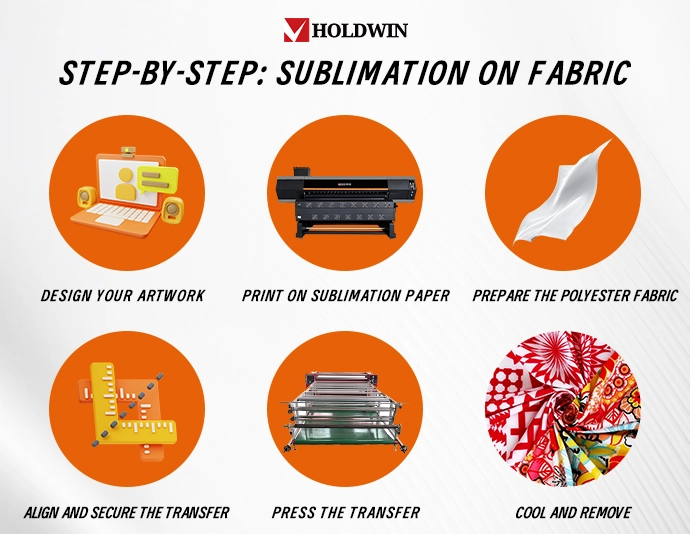
Step-by-Step: Sublimation on Fabric
Design Your Artwork:
Use graphics software (e.g., Adobe Photoshop or CorelDRAW) to create or import your design.
Critical Step: Remember to mirror your artwork before printing, as the transfer will flip during pressing.
Print on Sublimation Paper:
Load sublimation ink in your printer and print onto the white side of your sublimation transfer paper. Check your printer settings, ensuring you select the correct ICC profiles for accurate color reproduction.
Prepare the Polyester Fabric:
Place your fabric in the heat press for 5–10 seconds. This removes hidden moisture and flattens wrinkles, preventing “ghosting” or blurred lines later. Position the material perfectly flat on the lower platen of the heat press.
Align and Secure the Transfer:
Position the printed design face-down onto the fabric. Use heat-resistant tape to secure the edges and prevent shifting during pressing.
Press the Transfer:
Close the heat press and apply the recommended temperature (typically around 190–200°C) and pressure for the suggested duration (40–60 seconds, depending on the material). Refer to the product instructions or consult an up-to-date temperature chart.
Cool and Remove:
Open the press carefully to avoid shifting the paper. Let the fabric cool slightly, then peel off the transfer paper. Your design should now be bright and firmly bonded to the material.
Comparing Sublimation with Alternative Decoration Methods on Black Polyester
| Característica | Sublimation (Standard) | DTF (Directo – para – Filme) | DTG (Direto – para – vestimentos) |
| Process | Ink bond directly fibers to gas | Printed on film, coated with powder, heat pressed | Printed directly onto fabric via inkjet |
| White Ink? | No | Yes | Yes. Requires a white underbase. |
| Vibrancy | Fail. Design is invisible on black | Excellent. | Good to Great |
| Feel (Hand) | Perfect | Soft. | Médio |
Support Services Offered by Holdwin
Choosing the right partner for your printing business means more than just buying hardware; it is about securing a reliable production future. At Holdwin, we bridge the gap between advanced technology and daily operation through a dedicated support infrastructure. From the initial installation and software calibration to ongoing maintenance training and high-speed logistics, our team ensures your workflow remains seamless.
Key Take Away:
Mastering the art of sublimation requires a balance of the right chemistry, precise technique, and reliable equipment. By understanding the molecular bond between polyester and gas-infused inks, you can produce vibrant, retail-ready garments.