Which Products Can You Heat Press? A Complete Guide for Print Businesses

Which Products Can You Heat Press? A Complete Guide for Print Businesses

A. 热压机 gives you far more room to build a product range than T-shirt printing alone. So, which products can you heat press? In practical terms, you can work with many cotton, polyester, canvas, coated ceramic, and coated metal products, provided the material can handle the required heat and pressure.

For a growing print business, the real goal is identifying which products can be pressed reliably, repeatedly, and profitably. Separating flat textile items from shaped or rigid blanks simplifies inventory and workflow. It directly dictates your required pressure, platen contact, production speed, and equipment choice.

Which Products Can You Heat Press?

Modern heat press machines are commonly used with DTF (Direct-to-Film) transfers, sublimation transfers, and other heat transfer applications to customize a wide range of textile products and coated materials.

Apparel and Fabric Products

T-shirts and hoodies remain popular because cotton, polyester, and blended fabrics work with several common heat-transfer methods. Tote bags are another practical choice. Cotton and canvas usually sit flat on the platen and give you a generous print area.

Sports jerseys need more care. Polyester can react badly to excessive heat, especially on dyed performance fabrics. Scorch marks, unwanted shine, or dye migration can turn an otherwise good transfer into waste.

There is also a less obvious production detail. Thick seams, pockets, zippers, and tote handles can raise part of the fabric away from the platen. More pressure is not always the answer. Sometimes the blank simply needs better positioning.

Hard Goods and Promotional Products

Beyond garments, flat promotional items offer strong revenue potential. Mousepads, puzzles, can coolers, keychains, coasters, and coated aluminum photo panels integrate smoothly into flatbed transfer setups.

Drinkware and headwear require specialized equipment. Ceramic mugs, metal tumblers, and structured caps feature curved surfaces that standard flat platens cannot press evenly. They require dedicated mug presses, tumbler wraps, or cap attachments to ensure full, continuous contact. Judge equipment by the jobs it can execute consistently, not just the number of blanks that fit inside.

What Makes an Item Suitable for Heat Pressing?

Before adding a new blank to your catalog, check two things: how the material reacts to heat and how well the pressing surface can contact it.

Substrate Compatibility & Material Properties

A suitable blank must tolerate transfer temperatures without melting, shrinking, warping, or scorching. The transfer method must also match the material:  

  • 升华: Works best on 100% polyester or hard surfaces engineered with a poly-coating.  
  • DTF(直接到胶片): Excellent for cotton, poly-blends, canvas, and darker textiles.
Substrate / BlankDTF Transfer升华Recommended Settings
100 % CottonBest ChoiceNot Suitable*150°C – 160°C | 12 – 15 sec | Med Pressure
100 % PolyesterCompatibleBest Choice180°C – 200°C (Sub) / 140°C (DTF) | 35 – 45 sec | Med-High
Poly-Cotton BlendsBest ChoiceVintage / Faded150°C – 160°C | 12 – 15 sec | Medium Pressure
Canvas Tote BagsBest ChoiceCoated Poly Only160°C | 15 sec | High Pressure
Coated Ceramic MugsNot SuitableBest Choice180°C – 190°C | 180 – 200 sec | High Pressure
Mousepads & CoastersCompatibleBest Choice185°C – 190°C | 45 – 50 sec | Medium Pressure
Caps & Structured HatsBest ChoicePoly Only150°C – 160°C | 12 – 15 sec | Firm Contact

How Can the Right Heat Press Improve Production?

Once orders move beyond samples and occasional pieces, workflow becomes just as important as transfer quality. This is where press size, heating control, and station layout start making a noticeable difference.

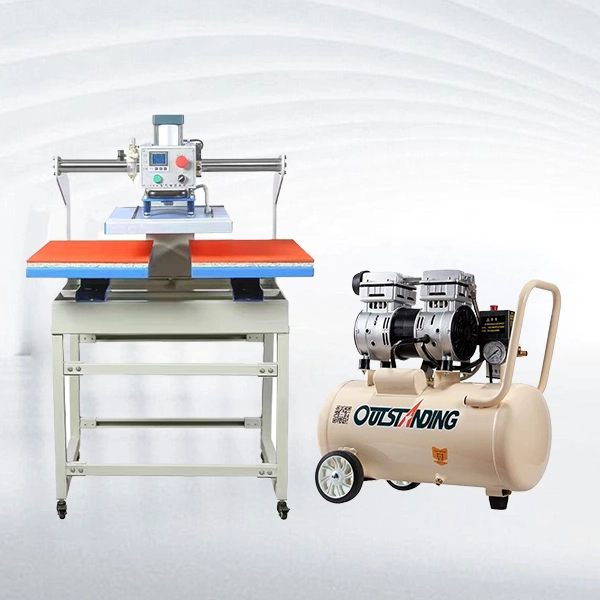
Practical 40 × 60 cm Pressing Area

全自动热压机

HOLDWIN热压机 uses a 40 × 60 cm pressing plate, giving you useful working space for T-shirts, hoodies, tote bags, fabric panels, and medium-to-large garment graphics.

Dual-Station Production Flow

The dual-station shuttle structure is especially useful when your orders become repetitive. While one station is pressing, you can position the next garment on the second station.

That sounds like a small change, but production often loses time between cycles rather than during the actual pressing step. Preparing the next piece while another is being transferred keeps the operator moving and makes the machine better suited to batch garment work.

Why Choose HOLDWIN for Your Heat Press Production?

霍尔德温, we have spent about 15 years working with digital printing and heat-transfer equipment for garment and textile businesses. We build printing and transfer machines around real production needs, from smaller custom jobs to repeated commercial runs. Our work also covers OEM and ODM requirements, technical guidance, remote support, and engineer assistance.

我们的 heat press equipments are designed with practical details in mind, to ensure that once the machine arrives, it can be put into immediate use. We focus on key aspects such as the heat being constant, the platen being of a suitable size, the controls being straightforward, and the workflow not involving the operator waiting between each press cycle. As with all of our equipment, we are here to support our customers after the installation of the machine and beyond the delivery of the machine.

Verdict

If you are still deciding which products to heat press, contact HOLDWIN and start with products that stay flat, tolerate heat well, and match the transfer method you plan to use. Then choose equipment around the orders you expect to repeat. 热压机 earns its place in a print shop when it makes those repeat jobs easier, faster, and more predictable.

Early peeling or cracking often points to incomplete bonding. Pressing time, temperature, pressure, transfer material, and fabric type all affect durability. A print shop should test unfamiliar blanks before moving into batch production.

In many cases, yes. A short pre-press can remove surface moisture and wrinkles, giving the transfer a flatter contact area. The exact time should still match the fabric and transfer process being used.

Instead of pressing on raised areas, try to avoid them whenever possible. Seams, pockets, and zippers can cause garments to not sit flat on the platen. By rearranging articles, or supporting certain print areas, for example, a smooth press is possible.

更多帖子

给我们发消息