English
  Arabic
  Chinese
  French
  German
  Portuguese
  Russian
  Spanish
  Polish
  Italian
Putting money into roll-to-roll furniture film and wall panel digital printing gear is a smart choice for surface decorators, cabinet makers, and wall cladding producers.
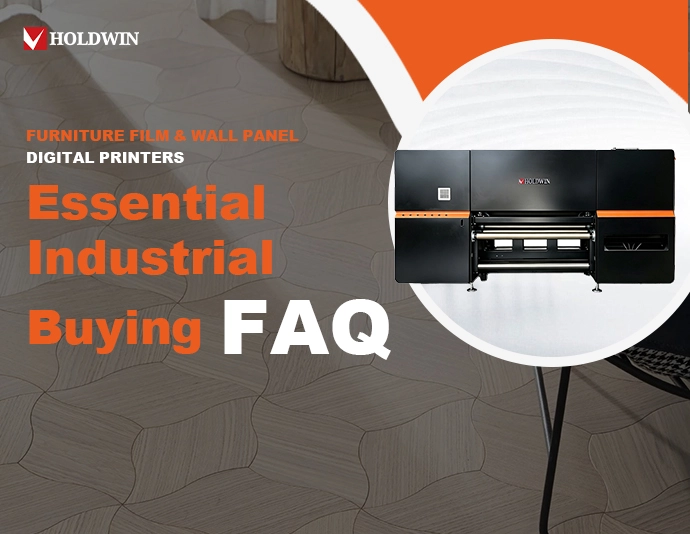
To help you evaluate equipment for your facility, here are the most critical technical and operational questions buyers ask before investing in systems like the HOLDWIN Series Furniture Film & Wall Panel Digital Printer.
1. Machinery Specifications & Production Capabilities
Ques-1: How is it different from a regular large-format printer?
Ans: Three things set decor printers apart:
- Roll handling built for heavy, wide rolls: These machines are designed to unwind and rewind rolls that can weigh around 1,000 kg and reach roughly 800 mm in diameter — far beyond what a standard sign printer handles.
- Ink formulated for lamination: Decor printers typically run weak solvent inks designed to bond well under heat-press lamination onto MDF, particleboard, or PVC — not the dye or pigment inks used for banners.
- Continuous production, not batch jobs: Print widths around 1,350 mm and multi-head configurations are built to run 8, 16, or even hours-long unattended jobs at production-line speed.
Q2: What speed tiers and output capabilities are available for large-scale manufacturing?
Ans:
Production speed scales directly with printhead array density. The HOLDWIN platform utilizes staggered industrial Epson i3200 E1 printhead banks to match different factory throughput requirements:
- HOLDWIN-1508 (8 Printheads): Delivers up to 80 m²/h in Production Mode, 60 m²/h in Standard Mode, and 40 m²/h in Quality Mode. Ideal for mid-sized production lines or specialized custom film runs.
- HOLDWIN-1516 (16 Printheads): Reaches 220 m²/h in Production Mode, 165 m²/h in Standard Mode, and 110 m²/h in Quality Mode. Suitable for continuous factory lamination shifts.
- HOLDWIN-1524 (24 Printheads): Achieves ultra-high speeds up to 350 m²/h in Production Mode, 248 m²/h in Standard Mode, and 165 m²/h in Quality Mode. Engineered to replace gravure cylinders on mass-scale manufacturing lines.
Q3: How does the 1350 mm print width fit standard architectural panel dimensions?
Ans:
The 1350 mm effective print width aligns directly with global decorative board standards (such as 4ft × 8ft and 4ft × 10ft panels, which measure 1220 mm wide). The extra margin allows full bleed coverage, trimming tolerance, and side-clamping room for vacuum thermoforming presses without wasting costly film media.
Q4: What materials can Furniture Film & Wall Panel Digital Printers print on?
Ans: This category of printer is built around roll-fed decor substrates: furniture film, wall panels, flooring film, plastic sheeting, fire-resistant panel facings, door-panel film, and similar decorative films used in commercial interior fit-outs and furniture manufacturing. For specific model configurations and capabilities, visit the Furniture Film & Wall Panel Digital Printer page.
2. Ink Chemistry, Adhesion & Color Performance
Q5: Why is weak-solvent (eco-solvent) ink preferred over standard UV inks for furniture films?
Ans:
While UV flatbed and roll-to-roll printers perform exceptionally well on rigid flatbed boards and display media, UV-curable inks form a hardened surface coat that can crack or micro-fracture when bent.
Industrial eco-solvent and weak-solvent ink systems subtly penetrate the polymer matrix of PVC and PET films without compromising substrate integrity. When cured, ink pigments anchor directly within the film layer. This preserves the original elasticity of the media, ensuring that downstream processes—such as 3D vacuum membrane pressing over detailed cabinet doors or 90-degree profile wrapping—occur without edge whitening, ink delamination, or surface cracking.
Q6: How does an 8-color ink configuration improve woodgrain and stone realism?
Ans:
Standard four-color (CMYK) printers build grays and earth tones out of coarse dot patterns — which is exactly what causes graininess or banding on marble, concrete, and light timber designs.
The Holdwin series avoids this with an expanded 8-color ink set: Cyan, Magenta, Yellow, Black, Red, Light Red, Gray, and Light Gray.
Gray and Light Gray: Cover the neutral, architectural palette — travertine, cast concrete, micro-cement, white marble — without faking gray from overlapping CMY dots, removing the speckled look on close inspection.
Red and Light Red: Widen the warm gamut beyond CMY, capturing the deep tones of teak, walnut, rosewood, and oak without looking orange or muddy.
The result: smoother gradients and a wider, more accurate color range for the two material categories decor customers care about most — wood and stone.
3. Engineering, Roll Handling & Automation
Q7: How does heavy jumbo roll capacity impact machine construction?
Ans:
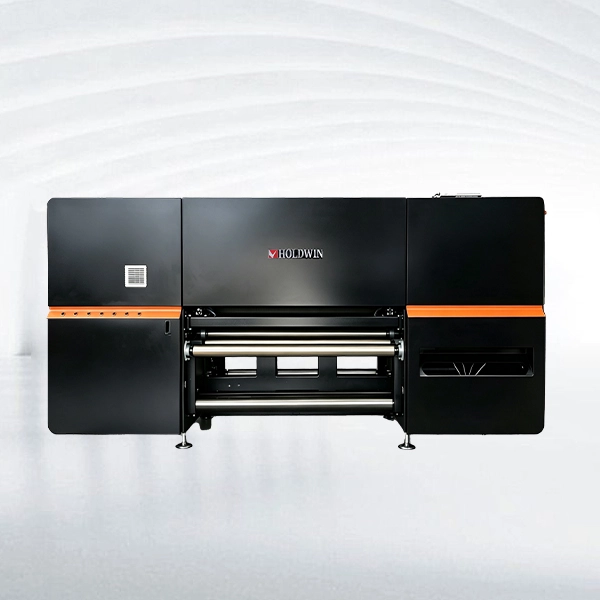
Bigger supply rolls mean fewer changeovers and less operator downtime — which is why the Holdwin platform runs jumbo rolls up to roughly 1,000 kg at diameters up to about 800 mm. Handling that much rotating mass shapes three key parts of the build:
Heavy-duty steel chassis: A reinforced frame (total system mass around 2,680 kg) absorbs vibration from rapid carriage movement, keeping dot placement accurate across the full 1,350 mm print span.
15L negative-pressure ink system: Bulk reservoirs per color, run through a closed-loop system, hold stable ink pressure at every nozzle even at sustained speeds up to ~350 sq.m/h — preventing starving or flooding.
12–30 kW drying stage: With no time to air-dry before rewinding, a multi-stage infrared/forced-air system flashes off the ink carrier before the film hits the take-up roll, preventing sticking or back-transfer.
In short, jumbo roll capacity isn’t just a convenience — it’s why the rest of the machine is built this heavy and this precisely.
Q8: What automated features protect printheads during uninterrupted factory operations?
Ans:
Industrial printhead maintenance is automated to protect capital equipment and prevent downtime:
- Automatic Flash Spraying: Regularly fires microscopic droplets from idle nozzles during standby to prevent ink drying on the nozzle plate.
- Automated Cleaning & Capping Stations: Executes automated suction cleaning, wiping, and airtight moisturizing cap sealing during pauses or overnight shutdowns to maintain nozzle health.
4. Integration, Environment & Facility Setup
Q9: What environmental conditions and power infrastructure are required?
Ans: To maintain precise drop-jetting trajectory and ink viscosity, install the equipment in a controlled industrial environment:
- Humidity: roughly 55% – 70%
- Temperature: roughly 22°C – 28°C (72°F – 82°F)
- Electrical Requirement: 210 – 230V AC, 50Hz / 60Hz (~4 kW base machine power; 12 kW to 30 kW dedicated drying line)
Q10: What key questions should buyers ask a machinery supplier before committing?
Ans:
Before finalizing a purchase order, evaluate your supplier through our technical services and support team with these core questions:
A few questions worth asking directly:
- Can you provide sample prints on my actual substrate, not just a generic test image?
- What’s the realistic, sustained (not peak) speed in Standard Mode on my materials?
- What’s the average printhead lifespan and replacement cost?
- What’s the typical lead time for spare parts and consumables to my region?
- Is remote engineer support available in my time zone and language?