What to Consider Before Buying a DTF Printer?

What to Consider Before Buying a DTF Printer?

Before you buy a DTF printer, start with your daily production needs. Compare print width, printhead count, white ink handling, powder curing, production speed, power requirements, required floor space, and consumable costs. A faster printer improves output only when the powdering, curing, film handling, and heat pressing stages can support the same workload.

Match the machine to your current workload, then leave room for growth.

DTF printing can be used for T-shirts, sportswear, workwear, bags, caps, shoes, and other customized textile products. It works with common garment materials such as cotton, polyester, blends, silk, nylon, and suitable leather applications.

HOLDWIN has worked with digital printing equipment for more than 15 years. When helping a buyer compare DTF systems, three questions come first: What do you print, how much do you print each day, and how quickly could that volume grow? See digital printing applications provides more examples.

Start with Your Real Production Needs

Start with your average daily transfer volume, the usual size of your designs, and the longest continuous production run you expect. A studio printing names, logos, and small custom graphics has different equipment needs from a shop producing 600 mm gang sheets or a factory running repeat orders for several hours.

Estimate Daily Output Before Comparing Machines

If most orders are custom names, logos, small graphics, or short apparel runs, a two-head setup may already cover your daily production.

If you run long batches or repeat designs for several hours, speed matters more. Printhead count and curing capacity then affect how many finished transfers you can complete in one shift.

Before choosing a printhead configuration, also think about how often your order mix changes. Frequent short jobs need quick setup, reliable film feeding, and easy cleaning more than maximum hourly output. Longer repeat runs place more value on continuous speed. This difference matters because the same machine can feel very different in a custom shop and in a workshop that runs the same design for hours.

Choose a Setup That Fits Your Growth

The most suitable setup depends on daily volume, film width, available floor space, and the amount of manual handling your team can manage. Use the following options as a starting point, then confirm the final configuration against your actual job mix.

Business Stage or Job Type

Production Needs

HOLDWIN Setup to Compare

Startup / Studio

Compact footprint, sheet-based work, and low daily volume

HOLDWIN HW30 + HOLDWIN-280 DTF Oven

Growing Print Shop

Regular 600 mm gang-sheet production

HOLDWIN-604I+DF604H

Mid-to-Large Factory

Continuous production and higher daily output

HOLDWIN-DTF6506i+DF0618B

Wide-Format Gang Sheets

Wider layouts and more designs arranged across each film run

HOLDWIN-DTF1208

Compare Printheads and Production Speed

When comparing printhead configurations, check the output available at the pass setting you expect to use for customer orders instead of looking only at the highest advertised speed. Then confirm that the powdering and curing equipment can process film at the same width and pace. This gives you a more realistic estimate of how many finished transfers the complete setup can produce in one shift.

Use a Two-Head Setup for Balanced Production

The HOLDWIN-602I+DF602B is a 600 mm DTF setup with two printheads, CMYK+W ink, and a matched powder shaker. It is a practical choice for custom apparel and small-to-medium production runs.
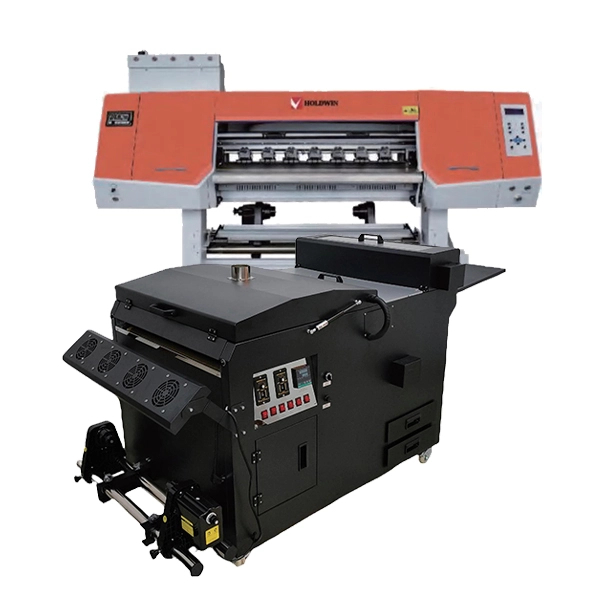
HOLDWIN-602I+DF602B

The 600 mm printing width allows several designs to be arranged on one roll as a gang sheet. This helps a growing print shop combine different customer jobs in the same production run and make better use of the available film area.

Move to Four Printheads When Output Starts to Hold You Back

If printed film becomes the slowest part of your process, a higher-output setup makes more sense.

The HOLDWIN-604I+DF604H combines a 600 mm four-head printer with an inline powder shaker and dryer. Its listed speed reaches 26 m²/h in 4-pass mode and 18 m²/h in 6-pass mode. This configuration can support larger repeat orders, longer runs, and tighter delivery schedules.
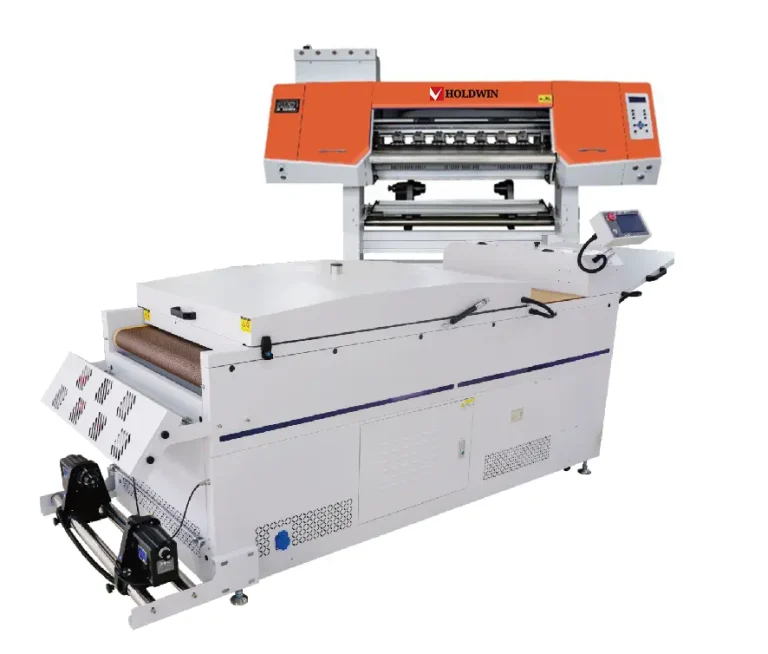
HOLDWIN-604I+DTF800S

Check the Whole DTF Workflow

A DTF printer is only one part of production. You also need DTF ink, transfer film, adhesive powder, curing, and heat pressing. If one stage is too slow, the whole line slows down.

Manual Powder Application and Standalone Curing

For low daily volume, a compact DTF printer can be used with manual powder application and a standalone curing oven. The HOLDWIN HW30 can be considered for compact, sheet-based production, while the HOLDWIN-280 DTF Oven provides a separate curing stage after the powder has been applied.

This setup takes up less space, but every printed sheet must be handled manually. Include the time required for powder application, excess-powder removal, curing, and heat pressing when estimating daily capacity. Buyers should also confirm that their sheet size fits the oven’s working area.

Automated Powder Shaking and Curing

For regular roll production, an inline powder shaker and dryer automatically applies adhesive powder, removes the excess, and cures the printed film. Systems such as the HOLDWIN-604I+DF604H support standard 600 mm production, while the HOLDWIN-DTF6506i+DF0618B is designed for higher-output production with six printheads.

The shaker and dryer must match the printer’s film width and production pace. Heat pressing remains a separate stage when the finished transfer is applied to the garment. Poor film, unstable white ink, or uneven powder can increase reprints. Our DTF ink management guide covers waste control, while our PET film guide explains coating and peel options.

Calculate Operating Cost and Workshop Space

Machine price is only the first cost. Ink, film, powder, cleaning materials, electricity, labor, maintenance, and failed transfers all affect your cost per finished print. Extra speed only pays off when you have enough work to use it.

Estimate these expenses per square meter of printed film or per finished transfer. This makes it easier to compare a lower-output setup with a faster system that uses more power, consumables, and floor space.

Check Power and Space Before Installation

Confirm the electrical requirements of the printer, curing equipment, and heat press separately before installation. Also allow enough space for film loading, powder handling, curing, heat pressing, cleaning, and routine maintenance. The complete setup may require more power and floor space than the printer alone. Check out our DTF printers while comparing options.

Conclusion

Before buying a DTF printer, compare your daily output, design size, required film width, curing method, electrical supply, and available workshop space. A compact printer with manual powdering and a standalone oven may suit low-volume work, while regular roll production usually benefits from an automated shaker and dryer. Four-head, six-head, and 1200 mm systems become more useful as order volume or gang-sheet width increases. HOLDWIN also provides service and technical support for installation, operation, maintenance, and troubleshooting. You can contact our team with your garment type, expected daily volume, preferred film width, and workshop conditions before choosing a setup.

More Posts

Send Us A Message