Printing Technology Trends in 2027: What Textile Printers Should Watch

Printing Technology Trends in 2027: What Textile Printers Should Watch

The textile printing industry is entering an exciting new phase of innovation. As customer expectations evolve and businesses demand faster production, greater customization, and more sustainable manufacturing processes, printing technology is becoming smarter, faster, and more versatile.

Looking ahead to 2027, textile printers will need to pay attention to more than just printing speed and machine performance. Developments in artificial intelligence (AI), automation, digital textile printing, advanced ink technologies, and sustainable production are expected to reshape how textile businesses operate.

Whether you run a garment printing business, manage a textile manufacturing facility, or are planning to invest in new printing equipment, understanding these emerging trends can help you stay competitive.

Let’s explore the major printing technology trends that textile printers should watch for in 2027.

AI and Sustainable Production Are Influencing Textile Printing

Artificial intelligence is creating new opportunities to improve textile printing workflows. AI-assisted design and image processing tools can support artwork preparation, pattern development, and image defect identification, helping businesses manage customized orders more efficiently. Combined with automated production workflows, these tools may help textile printers reduce manual preparation time and handle a wider variety of designs.

Sustainable production is another area receiving attention. More efficient ink usage, reduced material waste, and improved energy management can help textile printers optimize their production processes. As printing technologies continue to develop, businesses will increasingly evaluate equipment not only by printing performance but also by resource efficiency. Digital printing supports shorter production runs and on-demand manufacturing, helping businesses reduce unnecessary inventory and avoid some of the setup waste associated with conventional screen printing. Improvements in ink utilization, energy management, and material handling can further support more resource-efficient production.

DTF Printing Is Advancing in Speed and Production Capacity

Wider-Format DTF Systems Are Expanding Production Options

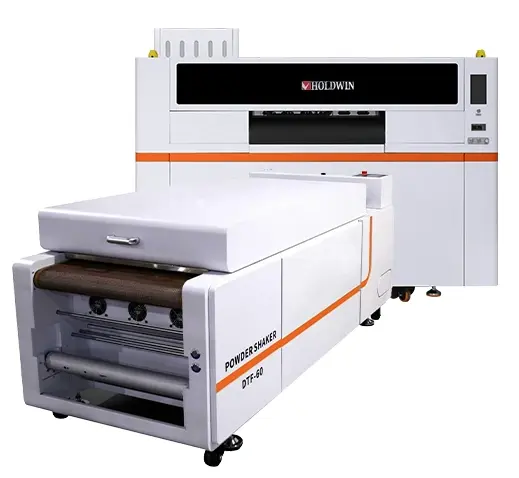
The HOLDWIN-DTF6506i+DF0618B combines a six-head, 600 mm DTF printer with an automatic powder shaker. Its rated printing speeds are 40 m²/h in 3-pass mode and 30 m²/h in 6-pass mode. For larger garment transfers, the HOLDWIN-DTF1208 offers a 1,200 mm printing width and eight printheads, with a rated speed of 45 m²/h in 6-pass mode. These are rated speeds, and actual output depends on the selected print settings and production conditions.

Wider printing systems provide more capacity for larger designs and high-volume orders, while 600 mm systems remain suitable for many standard garment transfers. The right configuration depends on the types of products being printed and the expected production volume.

Businesses looking to expand their production capabilities can explore HOLDWIN’s industrial DTF printers and automated powder shaker systems. These solutions support different production requirements, from standard garment transfers to higher-volume printing workflows.

dtf printer 6 heads

Real-World Printing Speed Is Becoming More Important

As textile businesses handle increasingly diverse orders, evaluating output under realistic production conditions is becoming more important. Two machines with similar rated speeds may deliver significantly different output over a full production shift. For more guidance on selecting suitable equipment, read our DTF printer buying guide for practical considerations covering printing width, printhead configuration, production speed, and equipment requirements.
 

powder shaker dtf

Advanced Ink and Adhesive Technologies Are Changing DTF Printing

Conventional DTF printing uses CMYK and white inks to print designs onto PET film. TPU adhesive powder is then applied to the printed film and heated before the design is transferred onto fabric. Ink, film, and adhesive compatibility all influence the quality of the final transfer.

White ink circulation and maintenance are also important because pigment settling can increase the risk of printhead clogging. As DTF production develops, improvements in ink formulations and consumable compatibility remain important for maintaining print quality and production stability.

Powderless DTF Technology Is Emerging as an Alternative

Powderless DTF technology is introducing another approach to garment transfer production. Unlike conventional DTF printing, which requires a separate adhesive powder application stage, some powderless DTF systems use specialized films or adhesive formulations to reduce the need for conventional powder application.

This approach may simplify production workflows and reduce powder handling. However, transfer durability, fabric compatibility, and operating costs still need to be evaluated for different applications.

Conventional DTF TPU adhesive powder remains important for established printing workflows. As powderless systems continue to develop, both technologies are likely to serve different production requirements.

Integrated Printing and Powdering Systems

  • Continuous Printing & Curing: Our automated DTF printing solutions seamlessly combine printing, powdering, and heat-curing into a single uninterrupted production line.
  • Hands-Free Operation: The HOLDWIN 600 mm DTF system feeds printed film directly into the automatic powder shaker machine, significantly reducing labor costs and setup time.
  • Consistent Print Quality: Automated powder distribution, precise curing temperatures, and optimal film tension ensure durable, professional transfers on every order.
  • Lower Total Cost of Ownership: Streamlined workflow integration cuts down material waste and energy usage. View our DTF equipment buying guide or get in touch with our sales team for a complete quote.

Conclusion

For textile printers, the key is not to adopt every new technology immediately. Instead, focus on the innovations that solve real production challenges, improve customer satisfaction, and create long-term business value.

2027 is an opportunity to print smarter, operate more efficiently, and prepare your textile printing business for the next generation of digital manufacturing. For personalized equipment recommendations and technical assistance, contact our team  to discuss your printing requirements.

More Posts

Send Us A Message