What is DTG printing and how does it work?
This state-of-the-art printing technology uses advanced ink jet technologies for transferring prints to fabrics. Direct-to-garment is a pretty simple procedure offering high-quality results in form of vivid images.
The procedure differs from conventional printing approaches as it allows bypassing additional procedures such as applying stencils or screens due to the way this technology operates.
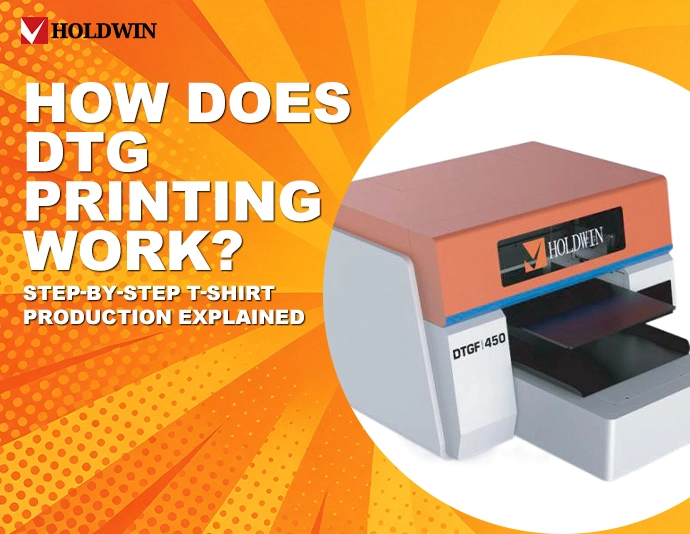
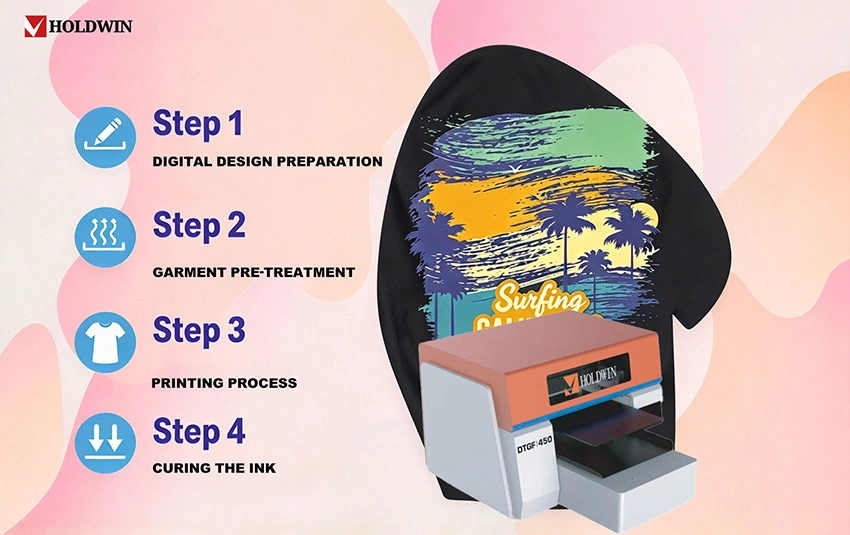
Here is how the DTG printing process works:
Creating digital designs: First, it is required to create or edit your digital design in form of PNG or JPEG files. Consider important factors such as transparent background, correct image size and high image resolution (300DPI or higher).
Pre-treatment: As one of the final steps of preparation, you need to pretreat your garment with a special solution that will make it possible to print on fabric without problems. Pretreatment makes images more vivid by helping water-based inks stick uniformly. Pretreating also prevents the image fading with washes as this procedure is essential in the DTG printing process.
NOTA: Pretreatment can be considered a primer for dark clothing pieces that need to be printed with white ink so it doesn’t fade away, smear or blur on dark fabric.
Proceso de impresión: The next step involves placing the garment onto a flat platen of the Impresora DTG. The printer applies small ink droplets directly on the fabric in layers. As a result, an accurate reproduction of a complicated design or gradients is possible.
Curing the ink: The final stage involves heating the fabric to make tinta DTG fixed in its fibers. For this purpose, either a heat press or conveyor dryer can be used. Thus, ink will not fade away even after several washes. Heating provides an additional advantage of smoothing out the print.
Comparison of Different Types of Digital Impresión
DTG vs. DTF: What’s the Difference?
DTG (Direct – to- Garment) delivers the softest results on cotton, while DTF (Direct – to- Film) works on wider range of fabrics and offers excellent durability, especially on synthetic materials.
| Factor | DTG (Direct – to-Garment) | DTF (directo – a – película) |
| How it works? | Ink is printed directly onto fabric | The design is printed onto transfer film and heat pressed onto fabric |
| Best Fabrics | Best suited for 100% cotton | Works on cotton, polyester, fabric blends, nylon and more |
| Sentir | Safe, breathable, and integrated into fabric | Slightly raised texture that sits on top of fabric |
| Mejor para | Premium Cotton T-shirt and soft, comfortable apparel | Versatile designs across different fabric types and garments |
| Calidad de impresión | Photorealistic prints with virtually unlimited colors | Versatile designs across different fabric type and garments |
DTG vs. Sublimation: What’s the Difference?
The short version: DTG owns cotton in any color, Sublimación owns all -over prints, but only on light polyester.
| Factor | DTG | Sublimación |
| How it works? | Ink sprayed directly into fabric | Dye turns into gas and bonds into polyester |
| La mejor tela | 100% algodón | Polyester only, light or white garments |
| Hand – Feel | Soft, absorbs into fabric | None, the dye becomes fabric |
| Garment Color | Works on dark and light | Light or white only |
| Mejor para | Soft cotton tees in any color | All – over vibrant prints on Polyester |
Conclusión: Just remember: cotton is king, pretreatment is essential, and proper care keeps prints looking great for years.
Optimizing Production with Holdwin Solutions
En Zhiyu Digital Technology (Holdwin), industrial DTG printing equipment—such as el HOLDWIN-DTG HW4810 y HOLDWIN-DTG4050i series—are built with integrated white ink circulation, auto-height adjustment, and high-precision printheads. Utilizing industrial equipment ensures consistent ink flow, reduced maintenance downtime, and superior output quality across high-volume production runs.
DTG durability depends on several factors: garment quality, proper pretreatment, and how the garment is cared for.
- With correct pretreatment and curing, DTG prints can withstand 40+ washes while maintaining good quality.
- DTG prints won't crack or peel the way some transfer methods do, because the ink is absorbed directly into the fabric.
- However, washing at high temperatures or using bleach will cause the print to fade faster.
To extend the life of DTG-printed clothing, follow these care guidelines:
- Machine wash cold, inside out, with mild detergent and similar colors.
- Don't use fabric softener—it can break down the print.
- Tumble dry low or hang dry, avoiding high heat that damages both print and garment.
- If ironing, turn inside out and use low heat—never iron directly over the print.
- Uses water-based inks free of harmful chemicals like PVC.
- Print-on-demand model drastically reduces inventory waste and overproduction.
Modern DTG equipment produces near-zero wastewater and uses less energy.
If your project involves producing small quantities of multi-color prints, then DTG is the right option.