English
  Arabic
  Chinese
  French
  German
  Portuguese
  Russian
  Spanish
  Polish
  Italian
As Generation Z, commonly known as Gen Z, places a higher value on unique fashion over mass-produced styles, the trend of personalized customization is transforming the apparel sector. The current landscape of e-commerce and fast fashion necessitates printing technologies that are versatile, efficient, and sustainable—standards that traditional techniques can no longer fulfill. Consequently, digital printing has risen to prominence, with HOLDWIN‘s white ink heat transfer machines at the forefront of this industrial evolution.
The End of the Screen Printing Era
Traditional screen printing has long dominated the garment printing industry, but its limitations are becoming increasingly apparent: the process is complex and highly dependent on manual labor, with numerous steps from plate making to finished product. This not only requires high technical skills from operators but also makes it easy for subtle differences in color and technique to affect the consistency of the finished product. In addition, its long production cycle and high cost make it difficult to adapt to the customized needs of small batch production and rapid response. More importantly, the pollution problems generated by traditional processes also conflict with increasingly stringent environmental protection policies, becoming an obstacle to the industry’s transformation.
| 📊 Deep Dive: DTF vs. DTG Cost Analysis: Which Method Saves Your Business More?
Enter the Digital Revolution
The emergence of digital printing technology has completely broken the shackles of traditional manufacturing. This technology, which integrates mechanical automation and digital information processing, has achieved a comprehensive upgrade in garment printing: no plate making is required, one person can manage multiple machines, significantly reducing labor costs; it supports printing from a single piece, flexibly handling personalized orders and small-batch production; visually, digital printing offers rich colors and natural transitions, highly reproducing complex patterns and subtle gradients while maintaining the soft touch of the fabric, enhancing the wearing experience. More importantly, its production process requires no washing and has low emissions, aligning with sustainable production trends and injecting green momentum into the industry.
| 📘 Essential Reading: Introduction to DTF Printers: Key Features and Benefits Explained
The HOLDWIN Edge: Precision Meets Power
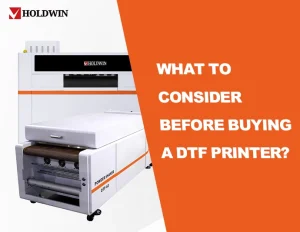
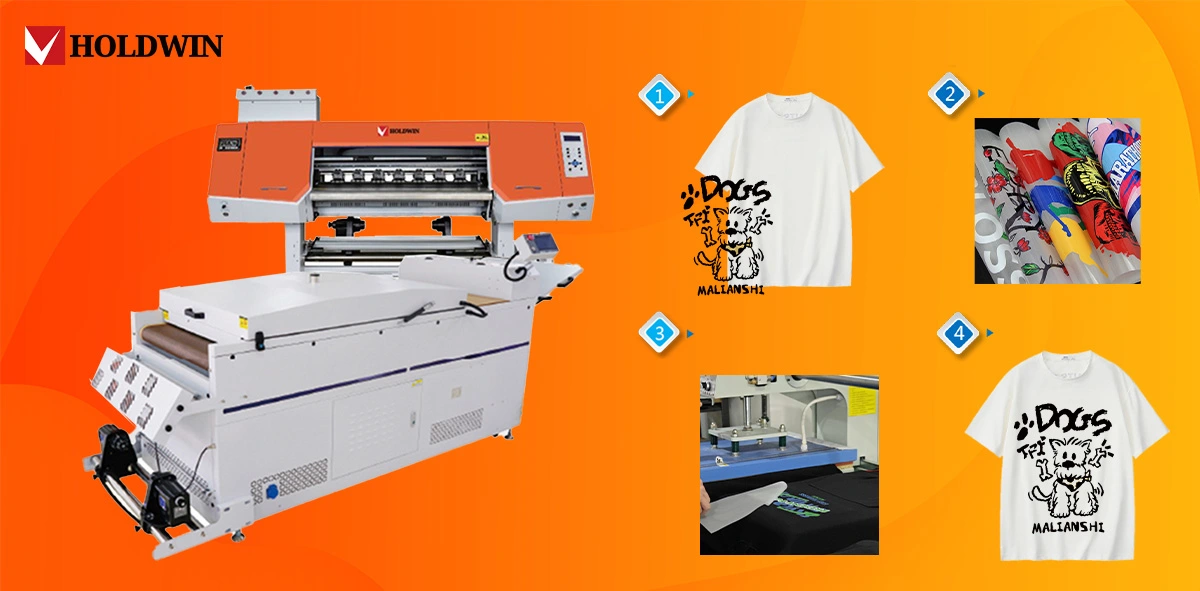
Among numerous digital printing equipment, HOLDWIN, with its years of industry experience, stands out. As a reputable brand focused on technology, HOLDWIN DTF printers have won widespread recognition for their stable performance. The product line covers 2-head and 4-head models, with the 4-head 604i+DF800S model considered a “performance benchmark”—using Epson i3200 printheads for higher printing precision; speeds reach 26 m²/h in 4-pass mode and 18 m²/h in 6-pass mode, easily handling large-volume orders. The printed patterns are vibrant, detailed, and have excellent colorfastness, remaining intact even after multiple washes, fundamentally solving the problems of cracking and lack of durability inherent in traditional printing methods.
| 🎨 Technical Guide: Understanding the CMYK Color Model: The Secret to High-Precision Printing
The Future is Personal: Is Your Business Ready?
The shift from traditional screen printing to digital heat transfer isn’t just a trend—it’s a survival strategy in a fast-paced market. HOLDWIN provides more than just machinery; we provide the freedom to create without limits. With the industrial speed and Epson i3200 precision of HOLDWIN, you can handle any order—from one-offs to bulk runs.
| ✨ Expand Your Business: 6 Creative Ways to Use UV DTF Technology for Premium Promo Products
Frequently Asked Questions: