English
  Arabic
  Chinese
  French
  German
  Portuguese
  Russian
  Spanish
  Polish
  Italian
For print shop owners, custom apparel manufacturers, and textile producers, digital sublimation printing has revolutionized the way we decorate fabrics and rigid materials. Unlike traditional printing methods that lay ink on top of a surface, sublimation achieves a permanent molecular bond.
But how exactly does this physical transition work under the hood? Understanding the core science and hardware mechanics behind a digital sublimation printer is the first step to maximizing your shop’s efficiency and avoiding costly production errors.
The Core Science: What is Sublimation?
In basic physics, sublimation is a unique phase transition where a solid substance turns directly into a gas without ever passing through a liquid phase.
In digital printing, this science is applied using heat-activated dyes and synthetic polymers.
The Dye Particles: Sublimation ink contains solid, nano-sized dye particles suspended in a liquid carrier liquid.
The Molecular Openings: When synthetic polymers (like polyester) are exposed to extreme heat (usually between 180°C to 200°C), their molecular structures open up like microscopic pores.
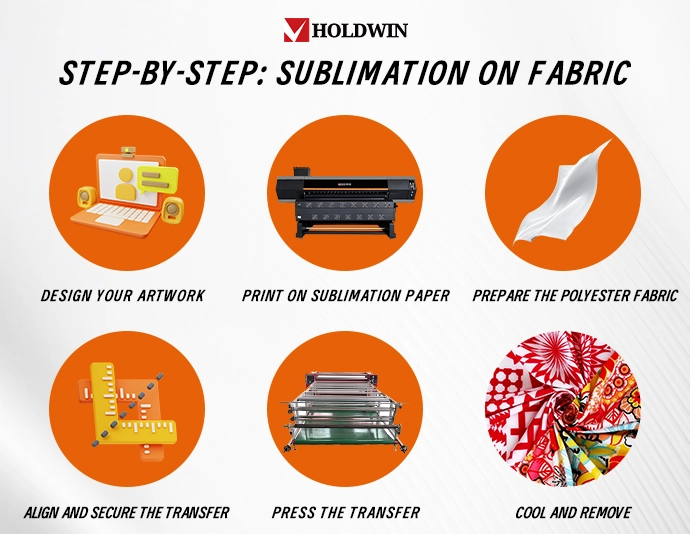
The Permanent Bond: At this exact temperature, the solid dye instantly vaporizes into a gas, shooting directly into the open polyester molecules. When the heat source is removed and the material cools, the pores close, trapping the solid color permanently inside the fibers.
The result is a print that will never crack, peel, or wash out, because the image is structurally part of the fabric itself.
💡 Recommended Sublimation Guides & Resources:
Final Thoughts: The Chemistry Behind Unmatched Print Durability
Understanding how a digital sublimation printer works comes down to a unique chemical transformation: turning solid dye directly into gas under intense heat and pressure. Because the gaseous dye opens and permeates the synthetic fibers before reverting back to a solid state, the design becomes an integral part of the substrate itself—rather than sitting on top as a surface film. This fundamental difference is why dye-sublimation produces seamless, vibrant, and soft-touch graphics that will never crack, peel, or fade, even after dozens of industrial wash cycles.
Whether you are scaling up custom apparel lines, producing promotional merchandise, or running high-volume home textile production, mastering the balance between printer resolution, specialized sublimation ink, and heat press calibration is what separates average results from commercial-grade quality.
Ready to Upgrade Your Sublimation Production Line?
Transitioning from small-scale setups to continuous industrial output requires equipment engineered for stability, color consistency, and long-term efficiency. At HOLDWIN (Shaoxing Zhiyu Digital Technology Co., Ltd.), we bring over 15 years of digital textile printing expertise directly to your facility floor—offering high-speed industrial sublimation printers, heavy-duty rotary calenders, and premium ink solutions with zero middleman markup.
Explore HOLDWIN Sublimation Printers & Solutions or reach out to our technical team today to map out the ideal print width, speed, and heat-transfer setup tailored for your daily volume.
Frequently Asked Questions
From design to finish, small runs like a dozen T-shirts wrap in under an hour. Larger fabric rolls might span a full day, depending on width and detail.
Pure cotton doesn't bond well—stick to polyester blends over 50% for best results. Pre-treat cottons if needed, but synthetics yield sharper, longer-lasting prints.
Wipe printheads daily, run cleaning cycles weekly, and check ink levels often. Full servicing every six months keeps them humming smoothly.