Russian
  English
  Arabic
  Chinese
  French
  German
  Portuguese
  Spanish
  Polish
  Italian
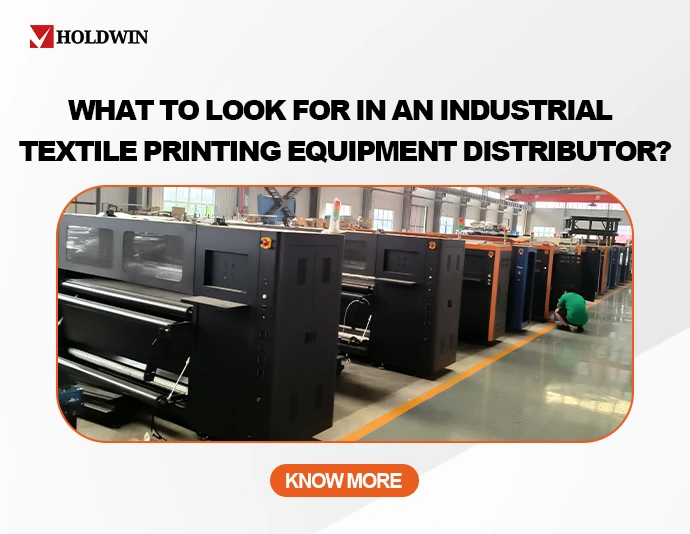
The choice of an industrial textile printing equipment distributor for your shop goes beyond comparing prices or print speed. A good distributor first needs to understand the specific needs of its customer: the type of fabrics printed, the application, the expected end product, the printing width, and the production flow.
Can the Distributor Match Equipment to Your Production Requirements?
A good equipment recommendation should start with your production requirements, not with a machine model. Before suggesting a system, the distributor should ask what materials you print, what products you make, how wide the media is, and how much output you expect.
Can They Recommend the Right Printing Process for Your Application?
Cotton, polyester, blended fabrics, garments, transfer paper, and other textile media may require very different printing workflows. The distributor should be able to explain when DTF, DTG, sublimation, direct-to-fabric, or UV printing is more suitable instead of trying to fit every application to one technology.
Can They Match Machine Capacity to Your Actual Output?
Daily output, working hours, order size, print quality, media width and number of job changes all need to be taken into account. A wider or faster machine is not automatically the better investment. Small machines are best suited for mixed short print jobs. Larger machines are better for continuous production of wide media.
Does the Distributor Offer the Right Range of Textile Printing Equipment?
A capable distributor should be able to compare several printing technologies rather than recommend the same type of machine for every customer. DTF, DTG, UV, sublimation, and heat-transfer production each involve different materials, consumables, operating skills, and supporting equipment.
Distributor Selection Checklist
| Equipment Category | Key Machine Models | Essential Distributor Requirement |
| DTF Printing Systems | HW30 Series | In-stock TPU powders, PET films, and expertise in automated shaker/curing alignment |
| DTG Industrial Printers | Холдвин-360 4S, Холдвин-DTG4050i | Hands-on experience with white ink agitation systems and precise pre-treatment workflows |
| UV Flatbed & Roll-to-Roll | HOLDWIN 4060, 6090УФ, 1612, ХОЛДВИН-1804H | Capability to configure multi-layer UV printing with white/varnish and support UV LED lamp maintenance |
| Sublimation & Heat Transfer | 1932TX, 1916TX, HW-800, HW-1000, ХВ-420З | Expertise in high-speed tension control, sublimation color profiling, and rotary calender heating consistency |
Each equipment category requires different application knowledge. A capable distributor should understand not only machine configuration but also the production workflow, расходные материалы, operating requirements, and technical support associated with each printing process.
Can the Distributor Support Stable Production After Installation?
Buying the right machine is only part of starting an industrial printing project. The stability of production also depends on other factors, such as the feed system, the ink system, the drying or curing system, the software, the operator, the maintenance and the technical support.
Production System Knowledge
DTF production requires control of white ink, powder application, and curing. Sublimation production depends heavily on media feeding, tension, drying, and heat transfer. ДТГ requires reliable pre-treatment and white ink management, while УФ-печать requires stable curing and media handling.
A distributor should be able to discuss these systems as part of one production workflow rather than focusing only on printhead resolution or maximum machine speed.
Software and Operator Workflow
Find out which RIP software, file types, color management and operating procedures you need before you buy. Your distributor should explain how the print device you are buying will fit into your current design and production workflow.
Installation, Training, and After-Sales Support
Industrial equipment usually requires setup, calibration, training of operators, cleaning, routine maintenance and possible troubleshooting. Ask who installs the equipment, who trains the operators, who delivers replacement parts and if possible remote support or on-site support is available.
How Should You Evaluate a Distributor Before Purchase?
The specifications of a machine do not tell you how a distributor is going to support your production after the sale. Ask for practical details about their service response, their range of spare parts, the provision of installation services and operator training, and about their dealings with previous customers.
Distributor Evaluation Checklist
| Evaluation Criteria | Key Questions to Ask | What to Look For |
| Technical Support | What is your average emergency service response time? | Clear response targets and access to remote or on-site technical support |
| Supply Chain | Do you stock critical spares and printheads locally? | Reliable access to essential OEM parts and matched consumables |
| Onboarding | What does the installation package include? | Installation, operator training, calibration, and workflow setup |
| Track Record | Can you provide references from similar print operations? | Relevant industry experience and references from comparable production environments |
Вывод
The right industrial printing equipment distributor should do more than sell a machine. Your supplier should understand your application, can compare relevant printing technologies, match machine capacity to your real production needs and support you after the installation.
Холдвин provides equipment across ДТФ, ДТГ, UV, сублимация, and related heat-transfer applications. Evaluate different systems based upon your original material, printing process, required width, target output and support needs. Choose the best equipment for the production you need to run.
Does the distributor have clear Product Specifications, Application Information, Installation Information, Training Information, Spare Parts Information and References to similar Print applications? It is your Distributor’s job to explain how their Products and Services can work within your specific Print process.
Ask about compatible fabrics and inks, realistic production speed, printing width, RIP software, installation requirements, operator training, maintenance schedules, spare-parts availability, warranty terms, and technical support. These questions help you compare distributors beyond machine price.
Industrial printers depend on printheads, ink systems, feeding components, curing or drying systems, and electronic parts. Faster access to replacement parts and technical assistance can reduce production interruptions when maintenance or troubleshooting is required.